Localization. Arabic and English, reviewed.
Approval-gated Arabic and English content with right-to-left aware delivery.
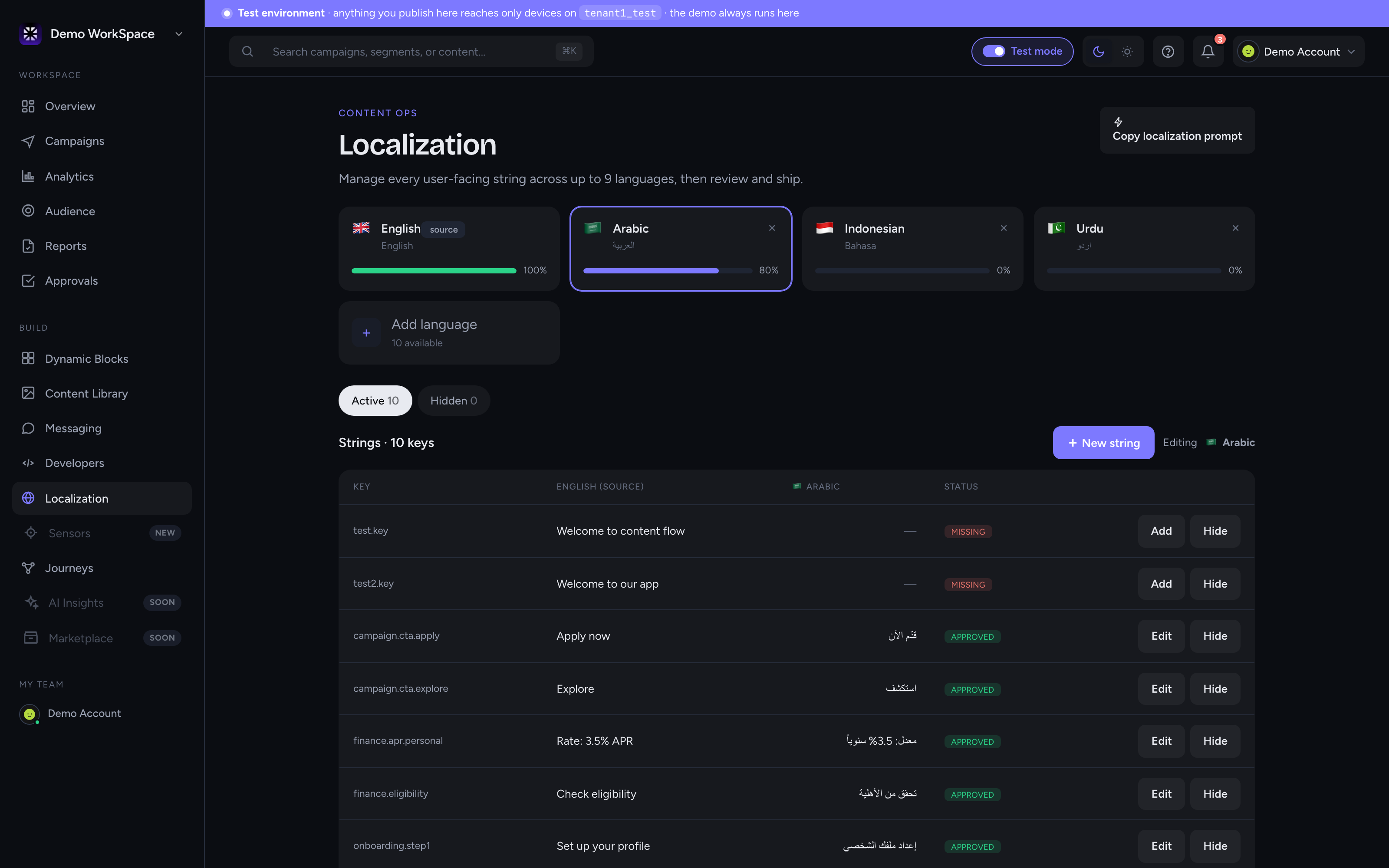
One string, two scripts.
Nothing publishes until a human approves the translation.
The layout mirrors for right to left, it is not a flipped screenshot.
The English card is the string still in review: with no approved Arabic, the app falls back to the source rather than publish an unreviewed translation.
The same screen, both languages.
What travels with every string.
Arabic content management
Teams can create, edit, review, and publish Arabic product content.
English content management
English variants are managed alongside Arabic.
Right-to-left content flag
The Arabic locale carries a right-to-left flag; the host application renders and mirrors the layout.
Locale-specific variants
Teams can maintain language-specific wording.
Approval-gated publishing
A string remains unpublished until the required human review is complete.
Locales in, content out in both.
Connect the REST API
Connect the application through the REST API and include the user's selected or resolved locale in content requests.
Implement locale fallbacks
Define how the application handles unsupported locales, missing translations, and right-to-left presentation.
Register supported locales
Add the required locales, default language, fallback order, and approved terminology for each market.
Translate and publish
Enter reviewed translations, compare locale variants, and publish only the versions approved for use.
Where Arabic and English have to agree.
Arabic Banking Guidance
A Saudi bank could maintain Arabic and English guidance for the same account servicing flow.
Regional Policy Wording
A regional insurer could maintain different Arabic terminology for policy content across its operating markets.
Bilingual Seller Content
A Saudi marketplace could provide seller instructions in Arabic and English from one managed content structure.
The layout mirrors. The words still need eyes.
Client Handles RTL
Right-to-left layout, font support, truncation, and mirrored interface behaviour remain responsibilities of the host application.
Translations Need Review
ContentFlow does not replace linguistic, legal, or product review of translated content.
What translators ask first.
Which languages are confirmed as shipped?
Arabic and English are confirmed. Content is delivered right-to-left aware for Arabic, while the host application renders the layout.
Is AI translation available today?
Yes. AI can draft a translation for any missing string, but every draft lands with review status and needs a person's approval before it ships. AI never publishes on its own. Arabic and English are the confirmed languages.
Does localization require engineering?
Engineering must connect product strings and rendering. Production integration today uses the REST API; native SDKs for React Native, iOS, Android and Web are in preview and are not generally available, and the @contentflow/cli package is not published yet. Routine content review and publishing can be handled by authorised teams.
Every product ships in two languages.
Dynamic Blocks
Dynamic Blocks can render approved Arabic and English content within native in-app placements.
Localization is one of eight.
Production integration today uses the REST API. Native SDKs for React Native, iOS, Android and Web are in preview and are not generally available. The @contentflow/cli package is not published yet.